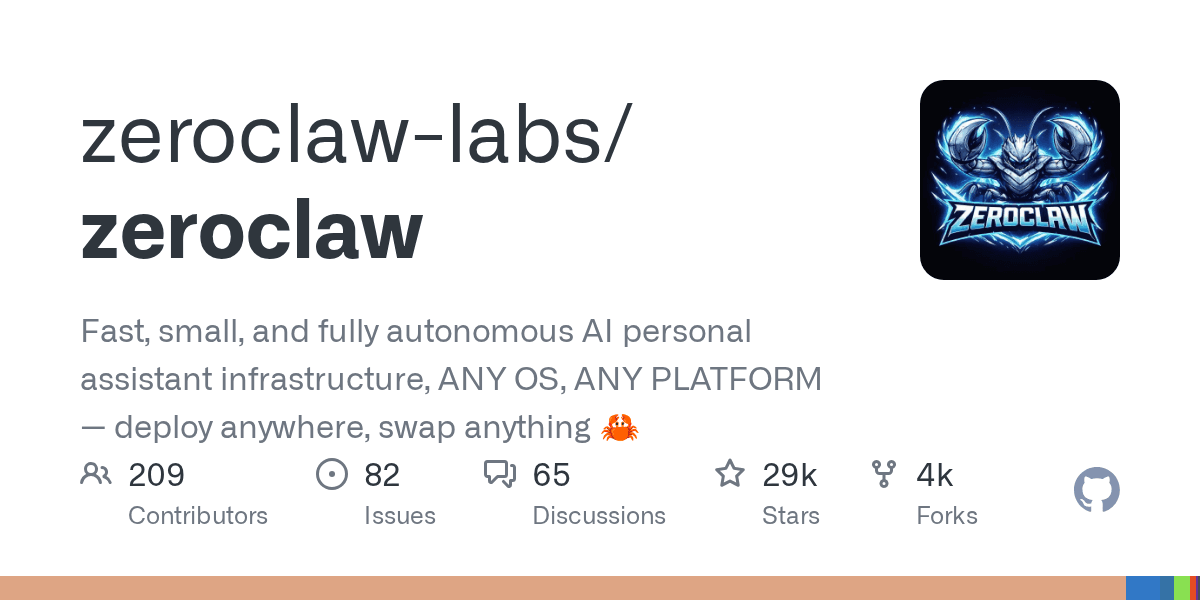

A new open-source project, ZeroClaw, is disrupting the personal AI assistant landscape by offering a fast, autonomous solution designed to run on minimal hardware. This Rust-powered infrastructure enables a fully customizable AI assistant on virtually any operating system or platform, significantly lowering the bar for local AI deployment. Developers can now deploy a personal AI that operates on channels they already use, requiring less than 5MB of RAM, according to ZeroClaw Labs.
ZeroClaw: Your Ultra-Lean AI Assistant
Imagine having a highly efficient, personal digital assistant that lives solely on your devices, completely under your control, and costs almost nothing to run. That's the promise of ZeroClaw. Unlike cloud-dependent AI services, this system is engineered for local-first operation, offering privacy and speed by design.
ZeroClaw acts as a central hub, connecting to your preferred messaging platforms—from WhatsApp and Telegram to Slack and Discord. It provides a web dashboard for effortless management, allowing users to interact with their AI, monitor its activity, and configure its capabilities in real-time. This flexibility ensures your AI assistant is truly yours, adapting to your specific needs and environment.
Under the Hood: Rust-Powered Autonomy
The core of ZeroClaw’s efficiency lies in its foundation: 100% Rust development. This choice allows for a single, small binary that boasts impressive performance metrics. The project runs on hardware as inexpensive as $10, requiring less than 5MB of RAM and achieving startup times under 10 milliseconds. This makes it viable for low-power devices like Raspberry Pis or even embedded systems.ZeroClaw's architecture is built around agnosticism, supporting a wide array of Large Language Model (LLM) providers such as OpenAI, Google Gemini, and Anthropic. It also features a "swappable" design for channels, tools, and memory, preventing vendor lock-in and promoting a truly open ecosystem. Developers can leverage a rich set of built-in tools for shell access, file I/O, browser control, and integrations with platforms like Jira and Google Workspace.
The system also introduces "Hands" for multi-agent orchestration, allowing autonomous agent swarms to run on schedule and evolve over time. Standard Operating Procedures (SOPs) enable event-driven workflow automation, triggered by webhooks, cron jobs, or even hardware peripherals like ESP32 and Arduino boards. This level of customization and control pushes the boundaries of personal AI.
Beyond the Desktop: Real-World Impact
ZeroClaw's design addresses a critical need in the rapidly expanding AI landscape: localized, efficient, and secure autonomous agents. For developers, this means the ability to integrate advanced AI capabilities into custom projects without the overhead of heavy cloud infrastructure. Its low resource footprint opens up possibilities for edge computing and IoT applications, transforming ordinary devices into smart, responsive assistants.
The project’s emphasis on security is also notable, featuring default DM pairing, strict sandboxing, explicit allowlists, and multiple autonomy levels (ReadOnly, Supervised, Full). These measures ensure that personal AI remains private and protected. ZeroClaw represents a significant step towards democratizing access to powerful AI, putting sophisticated tools directly into the hands of users and developers, rather than restricting them to large data centers.
Quick Stats
- ZeroClaw uses less than 5MB of RAM on release builds.
- It achieves cold startup times of under 10 milliseconds.
- The entire project is built with 93.7% Rust code.
- It runs on hardware costing as little as $10.
- The GitHub repository has garnered over 28.8k stars.