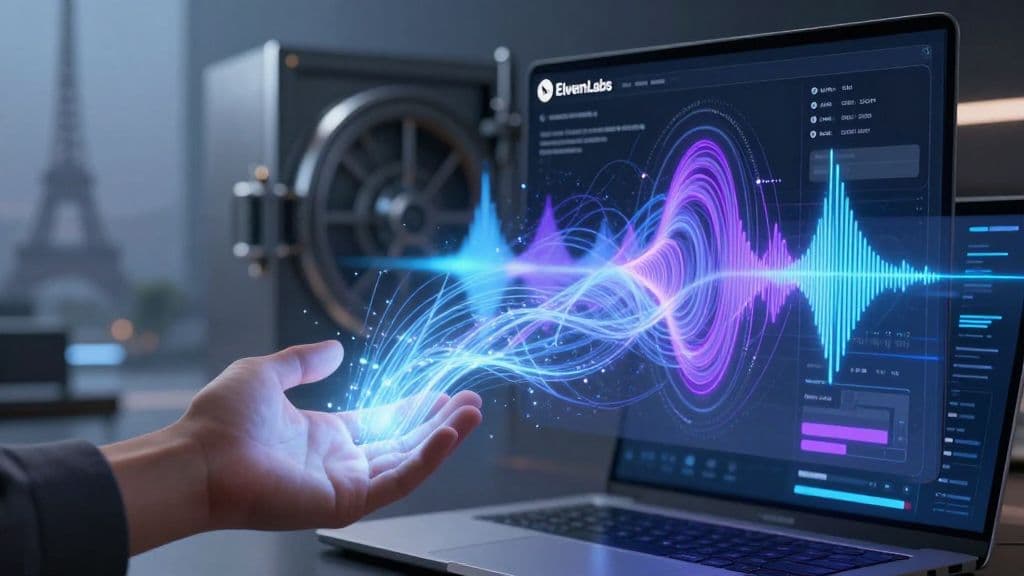

Mistral AI has launched Voxtral TTS, an open-weight text-to-speech (TTS) model designed for enterprises that claims to outperform ElevenLabs in key areas and run efficiently on edge devices. This move, reported by VentureBeat, directly challenges the dominant proprietary voice AI market, offering companies full control over their speech generation infrastructure instead of a rented service. The strategic release marks Mistral's latest step in assembling a complete, enterprise-owned AI stack, positioning it as a leading alternative to closed systems.
Why Open Weights Disrupt Enterprise Voice AI
The enterprise voice AI market, valued at over $22 billion globally in 2026, is fiercely competitive. Major players like ElevenLabs, IBM, Google Cloud, and OpenAI typically offer proprietary, API-first services. This means businesses rent voice capabilities, sending their audio data to third-party providers.Mistral AI enters this arena with a fundamentally different approach. It releases the full model weights for Voxtral TTS, inviting companies to download and run it on their own servers or even smartphones. This enables enterprises to maintain complete data sovereignty and avoid sending sensitive audio frames to external parties. Mistral bets that control, not just sound quality, defines the future of enterprise voice AI.
The Paris-based AI startup, valued at $13.8 billion, has been aggressively building a comprehensive enterprise AI stack. This includes its Forge customization platform and Voxtral Transcribe speech-to-text model. Voxtral TTS completes this picture, offering an output layer for an end-to-end speech-to-speech pipeline entirely within an enterprise's control.
Voxtral's Technical Prowess and Performance Edge
Voxtral TTS features technical specifications that defy typical industry standards for frontier models. Mistral built a model roughly three times smaller than comparable quality offerings, yet it delivers impressive performance. The architecture includes a 3.4-billion-parameter transformer decoder backbone for language understanding, a 390-million-parameter flow-matching acoustic transformer for sound generation, and a 300-million-parameter neural audio codec for efficient audio encoding, all developed in-house.
The system is built on Ministral 3B, the same backbone powering Voxtral Transcribe, showcasing Mistral's commitment to efficiency. It achieves a rapid 90 milliseconds time-to-first-audio (TTFA) and generates speech at approximately six times real-time speed. Quantized for inference, it requires about 3GB of RAM and operates in real-time on any laptop or smartphone, even on older hardware, according to GIGAZINE.
The model supports nine languages: English, French, German, Spanish, Dutch, Portuguese, Italian, Hindi, and Arabic. It adapts to custom voices with as little as five seconds of reference audio. Remarkably, it demonstrates zero-shot cross-lingual voice adaptation. For example, a French-accented voice sample can generate German speech retaining the original accent and vocal characteristics. This capability transforms cascaded speech-to-speech translation for multinational operations.
A Complete Enterprise AI Stack
Mistral AI explicitly aims to displace competitors. In human evaluations, Voxtral TTS achieved a 62.8% listener preference rate against ElevenLabs Flash v2.5 on flagship voices. It widened that gap to 69.9% preference in voice customization tasks, per TechCrunch. Mistral also claims the model performs at parity with ElevenLabs v3, their premium tier, on emotional expressiveness, while maintaining the faster Flash model's latency.ElevenLabs operates a closed platform with tiered subscriptions, scaling to over $1,300 per month for business plans. It does not release model weights. Mistral's open-weight model offers competitive quality and dramatically more favorable economics at scale. Pierre Stock, Mistral's vice president of science, stated, "AI is a transformative technology, but it has a cost. When you want to scale and have impact on a large business, that cost matters. And what we allow is to scale seamlessly while minimizing the cost and maximizing the accuracy."
This move is part of Mistral's broader strategy. The company is assembling a full AI stack: Voxtral Transcribe for speech-to-text, Mistral's language models for reasoning, Forge for customization, AI Studio for production infrastructure, and Mistral Compute for GPU resources. Voice agents—AI systems that listen, understand, reason, and respond in natural speech—are the unifying use case for these layers. The 90-millisecond TTFA is critical for natural, interruptible voice interactions that distinguish effective voice agents from static chatbots.
Mistral's open-weight approach aligns with a broader industry shift, even championed by Nvidia. CEO Jensen Huang declared at GTC that "proprietary versus open is not a thing — it's proprietary and open." Mistral is a founding member of the Nemotron Coalition, a collaboration to advance open frontier-level foundation models. This strategy drives adoption while Mistral monetizes through platform services, customization offerings, and managed infrastructure.