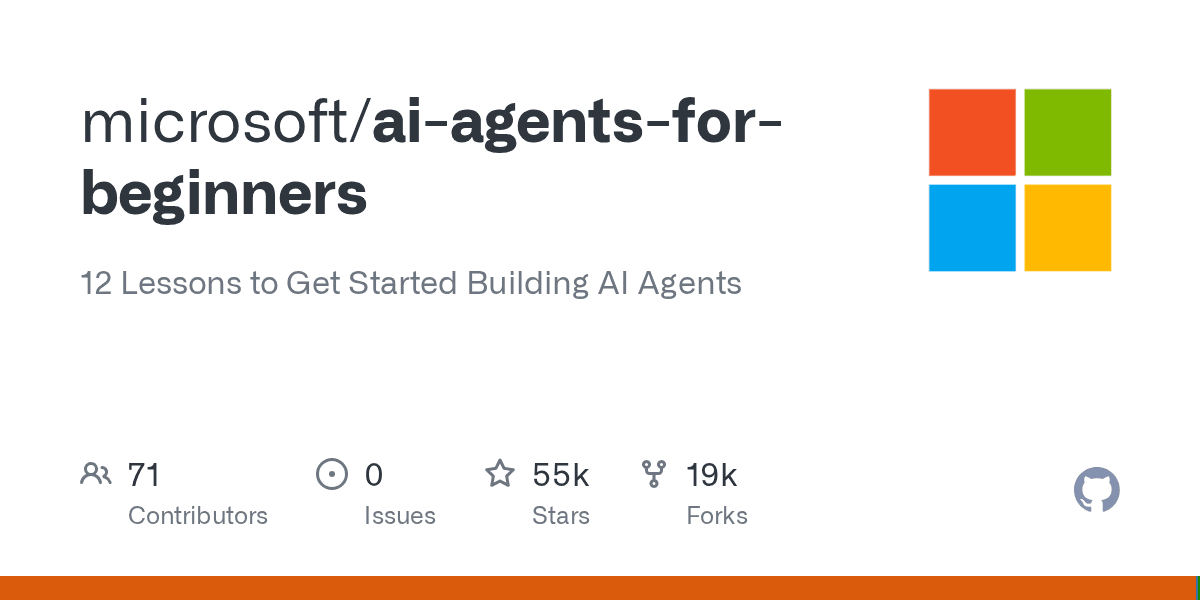

Microsoft has launched a comprehensive, free 12-lesson course, "AI Agents for Beginners," designed to equip developers with the skills to build autonomous artificial intelligence agents. This practical curriculum, available on GitHub, covers foundational concepts to advanced production strategies, empowering creators to leverage AI in new ways. The course quickly gained traction, accumulating over 55,000 stars on GitHub, reflecting the surging interest in agentic AI systems.
Imagine AI agents as highly capable, specialized virtual assistants that don't just answer questions but can autonomously plan, execute multi-step tasks, and even learn from their environment. Unlike simple chatbots, these agents can wield various "tools," access memory, and coordinate with other agents to achieve complex goals, much like a skilled project manager delegates tasks and oversees progress. This shift from passive AI to active, decision-making agents is rapidly transforming how businesses approach automation and problem-solving.
Mastering Autonomous AI Agent Development
The "AI Agents for Beginners" course offers a structured path through the core principles of agent construction. It begins with an introduction to AI agents and their diverse use cases before diving into exploring agentic frameworks. Key topics include understanding agentic design patterns, teaching agents to use external tools, and implementing Agentic Retrieval Augmented Generation (RAG) for more informed decision-making. Developers also learn critical aspects like building trustworthy AI agents and designing effective planning strategies.
The curriculum further extends into advanced concepts such as multi-agent systems, where multiple agents collaborate, and metacognition, which involves agents' ability to reason about their own thinking processes. It also addresses the practicalities of deploying AI agents in production environments, using agentic protocols, and managing agentic memory. The course includes Python code samples leveraging the Microsoft Agent Framework and Azure AI Foundry Agent Service V2, providing hands-on experience. This extensive resource offers multi-language support, ensuring accessibility for a global developer audience.
The Impact of Agentic AI on Work and Security
The rise of AI agents is not just a technical shift; it's redefining productivity and demanding new approaches to security. Billionaire investor Mark Cuban predicts that AI agents will eventually cut an hour from typical workdays, allowing employees to maintain productivity with reduced hours, according to Business Insider. This future depends on businesses adopting these autonomous tools to enhance operational efficiency across various sectors, from healthcare fraud detection to intricate financial analysis.
However, empowering AI with autonomy introduces new security and governance challenges. Microsoft is actively addressing this by introducing preview features in its AI platform, Microsoft Foundry, allowing companies to create guardrails for agent actions and enhance visibility into their configurations. The company also expanded its Security Triage Agent and launched a new Security Analyst agent for deep investigations, according to Dark Reading. The need for better governance frameworks is paramount, as highlighted by the rapid growth of platforms like OpenClaw, which Nvidia CEO Jensen Huang compared to Linux in its potential impact on AI, having surged to over 250,000 GitHub stars by March 2026, MLQ.ai reports. Meanwhile, companies like Promptfoo have raised over $23 million to help developers secure LLMs and AI agents, SecurityWeek notes.
This comprehensive course prepares developers to not only build these powerful agents but also to understand the crucial implications for security and responsible deployment. Mastering agentic AI ensures developers are ready for the next wave of autonomous systems.